
Dev log 2 lessssgoooooo!
Been some big changes round these parts since the last log – the male character model got a facelift, movement mechanics are in, building systems were built, and mod support is setup from the ground floor – let’s get into it.
Face Overhaul 2: Electric Boogaloo
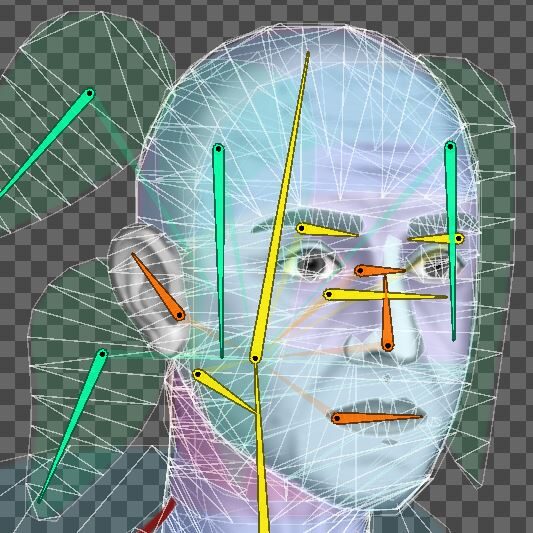
Alright, one of the coolest (and most painstaking) changes I’ve made is to FINALLY bring the faces up to an acceptable standard, and they look mighty fine if I say so myself (which I do). This was a whole weekend’s worth of work, but I am thrilled with the outcome – to the point where the old faces look shockingly bad in comparison. Have a look for yourself:

Pretty massive difference huh?
I will say, faces absolutely SUCK to draw – trying to get the proportions/dimensions right for all the different features, whilst also working with dozens of layers, and accounting for customisation and animation, and getting the eyes to look natural, and trying to avoid uncanny valley…. ugh that was WORK, lemme tell ya. When I was a kid and used to draw little army men, I always used to give them gas masks or facial bandannas…. and I now remember why.
Despite all my pain and suffering… it’s done. It looks great and (most importantly) it’s fully compatible with all the game’s systems, so now we finally got a solid base to work off. I am also in the process of revising the rest of the character model too, in order to bring it in line with the now higher fidelity face, and so you’ll likely see that in the next dev log. Luckily for me the face is really the hardest part, and the rest shouldn’t take anywhere near as long.
Character Movement (Jank central)
Next up we got in-game movement and animations, so the player is now able to walk, run, crouch, and jump, and all of these actions have their respective (placeholder) animations. I also implemented functionality for wall-checks, wherein the character will stop moving if they are up against a wall, as well as ceiling checks for crouching, which are both just nice little bits of polish that I personally appreciate in other games.
I’ve also implemented a very basic ragdoll system, so every character will have proper full-body physics when they get shot, get smacked, get thrown around by explosions, get sucked into space, and many many other terrible ways they can die (sorry little fellas).
Let’s look at the walking first (excuse the animations, they’re terrible I know – they will be updated soon):

And now the running (with a somewhat worse animation than the prior):

Aaaaaand now the crouching (with what is probably the worst couching animation I’ve ever seen lmao):

Finally, a small demo of the early body physics/ragdolling – do note that I haven’t yet tuned many of the variables regarding mass/gravity/inertia/etc, and so the actual physics itself will be far more refined (and less twitchy) as time goes on:

There we have it; a very basic but foundational movement system for the characters, which is pretty exciting as it means I now get to move on the more fun stuff. All of this movement is going to get another update pass soon, once I get to adding furniture and interactive objects. I fully intend to re-do all the animations from scratch and add lots of QoL features (such as physics enabling for arms/legs briefly when coming in contact with surfaces, and stuff like that).
Speaking of furniture, that’s a perfect segway into the next topic:
The Building System
Here we are, one of the coolest and most expansive parts of the game, which will cover player ship-building, player stations, player outputs, and mod locations – the building system.
I have now fully coded the bare-bones mechanics of the game’s building system, and this will serve as a foundation for expansion as the game goes on. Currently, the script is written for an in-editor Unity tool (which won’t be shipped with the game) and will mainly be used for me to design vanilla locations, but the very same code is what I will also use for the in-game builder.
So far I have support for floors, dividing walls, ceilings, room corners, and interior walls (the kind that the character walks in front of), and soon plan to add doors and windows and all the other basic building blocks. The demo below only showcases the current implementations, but rest assured, furniture and decor will be arriving next.

Pretty freakin’ cool ain’t it? The textures are obviously just placeholder for now, but they do their job fine enough.
EDIT: the above GIF shows a ‘freeform’ style of building (individual pieces), but I’ve since realized that (as a solo dev) it’s not worth the ROI to have my building system like this – and would be far more efficient, simpler, and less bug-prone, if I go with a ‘compartment’ system instead. So basically what this means is, when you (the player) are building your ships/stations/outposts, you’ll be placing down room prefabs of varying sizes (ie. 1×1, or 1×2, or 1×3, etc) and then using these rooms you can then change the all the individual pieces as well as set doors and windows. This means that the customization potential will still be there, but now the game will be able to track whole rooms rather than trying to dynamically calculate room bounds.
This means far cleaner code, far better performance, and far less tech debt for me (which is especially important, since I’m no code wizard), and overall just a simpler and easier way of building things. This also means I can include even more variety in build locations for outposts, such as planets and asteroids, as well as in space and underwater. Each of these compartments will also continuously track various hazards and conditions such as: Space Vacuum, Water, Power, Damage, Gas, Air Quality, and more.
In terms of the damage model, it will still retain full damage potential, even with this new system, as the individual pieces will all still track independantly (just part of a larger ‘room’ prefab) – so rooms can still be be set on fire, breached, destroyed, and all that cool stuff.
Expect to see a lot more of this system in the coming months, especially once I get up to the in-game building (and UI). Now the next (and equally awesome topic):
The Headline Act:
Mod Support
Yep, that’s right, MOD SUPPORT. Stellar Wasteland will 100% ship will full and extensive modding capability for every single aspect of the game. I’m talking Steam Workshop, Nexus Mods, hell – even Loverslab, we’re goin’ all the way baby.
Every single part of the game will be user-modifiable, and the game itself will support unlimited user generated content. No pesky ba2 limits here, no sir. That means that right-out-the-box the game will allow for: custom body parts, custom inventory items (clothing, armor, headwear, backpacks, etc), custom tattoos, custom hairstyles, custom weapons (and attachments), custom building blocks, custom ship parts, custom locations, custom star systems, custom everything.
I’m building the architecture of this game to support all of these things from the get-go, and so far I’ve already created scripts which read the mod folder, parse the mod files/textures, and add the custom item in-game at runtime. The example guinea pig for this functionality is a (very terrible looking) brick wall which, I can happily say, is now completely integrated in-game via code whenever the game is run, and works just like a vanilla item.
If that’s not cool enough, I’ve made the actual mod creation process SUPER easy (especially for adding new items that use vanilla item functionality), so let’s check that out below:

As you can see, the mod structuring is incredibly simple (atleast for this kind of item) and will create a ‘Mod Kit’ download package on the website, once the game launches, which will have all documentation and example mods for the game, so that even inexperienced users can easily create their own content.
The mod support doesn’t end at custom assets either – I intend to include full support for script mods too by adding integration support for the Harmony 2 Patching Library. Even if you’re mainly a player and not a modder, you’ve likely seen Harmony countless times as a required download for many games with large mod communities (Rimworld, Rust, 7 Days to Die, Stardew Valley, etc) and this basically allows modders to modify and add game scripts, leading to mods which add new mechanics, new features, new modes of play – the possibilities are endless. Integration for this will come far far later down the track, of course, but it’s something I’m set on addding.
In reading all that, you may wonder why I’m so excited about mod support – as on it’s own it’s probably less substantial of a topic than the previously covered ones in this post, especially if you’re a non-developer/modder. Well, one of the first things I always look for when deciding on a new game, is whether of not there is a Workshop or Nexus page, and if there is then it’s almost always a guaranteed purchase. A vibrant mod community can mean the difference between 50 hours game-time, or thousands of hours game-time, and this is probably most evident when looking at Skyrim or Fallout. Those games released over 10 years ago, and there’s still hundreds of mods being uploaded each month with tens of thousands of downloads. It really does make that much of a difference. Now – obviously – I don’t expect my game to ever reach Bethesda-status of modding, as it’s a far more niche game/audience, but if it’s lucky enough to achieve even close to a Project Zomboid/Rimworld level of modding, then that’s an ultimate win for me.
So yeah – that about sums up this dev log, lot’s of big additions since the last one – most importantly being that an actual game is finally taking shape. The next areas of work will be on adding a female character model, additional body types, and an inventory system (big milestone that one), so there’s a lot of exciting things to come.
I hope you enjoyed reading all this, and I’ll catch ya in the next one!