
Welcome back folks, another week another log. We got some exciting stuff this time rough though. Since most of the past two weeks’ development has been on the back-end, I thought I’d drop a whole bunch of the lore behind the game, which is far more exciting to show off and hopefully quite interesting to read.
Dev Stuff Now, Cool Stuff Soon
So to start off, I thought I’d just explain why there isn’t a huge deal of in-game stuff to show off. These past two weeks I’ve mainly been working on adding lots of small (but significant) QoL additions and features, and have also done a major restructuring of the background architecture of the game. To spare you from the boring bits, it was basically a lot of trial and error, including a bunch of lost time spent on incorrect solutions, but overall a solid boost to the optimisation of the game and all its assets – especially when large numbers of NPCs are on screen later down the line.
So then, apart from of all this technical work I’ve done behind the scenes – what is there actually to show?
Well, I’m glad you asked, since I’ve created the following GIF to show off all the new bits and bobs in one fell swoop. Some of the new things include:
– Zoom and Pan functionality (finally!)
– Age slider now appropriately greys hair dependant on age
– Skin-tone slider darkens body hair in line with skin-tone (No more dark complexion characters with bright blonde chest hair)
– Clothing toggle now has proper UI integration
– Fields now remember user selections when changing body types (and, where applicable, gender)
– Anatomy-related fields *were* supposed to be sliders by now, but I ran into a few issues and didn’t manage to get that done in time for this log – but I’ll be updating that early next week (No genital thumbnails, cause the game ain’t meant to be porn)
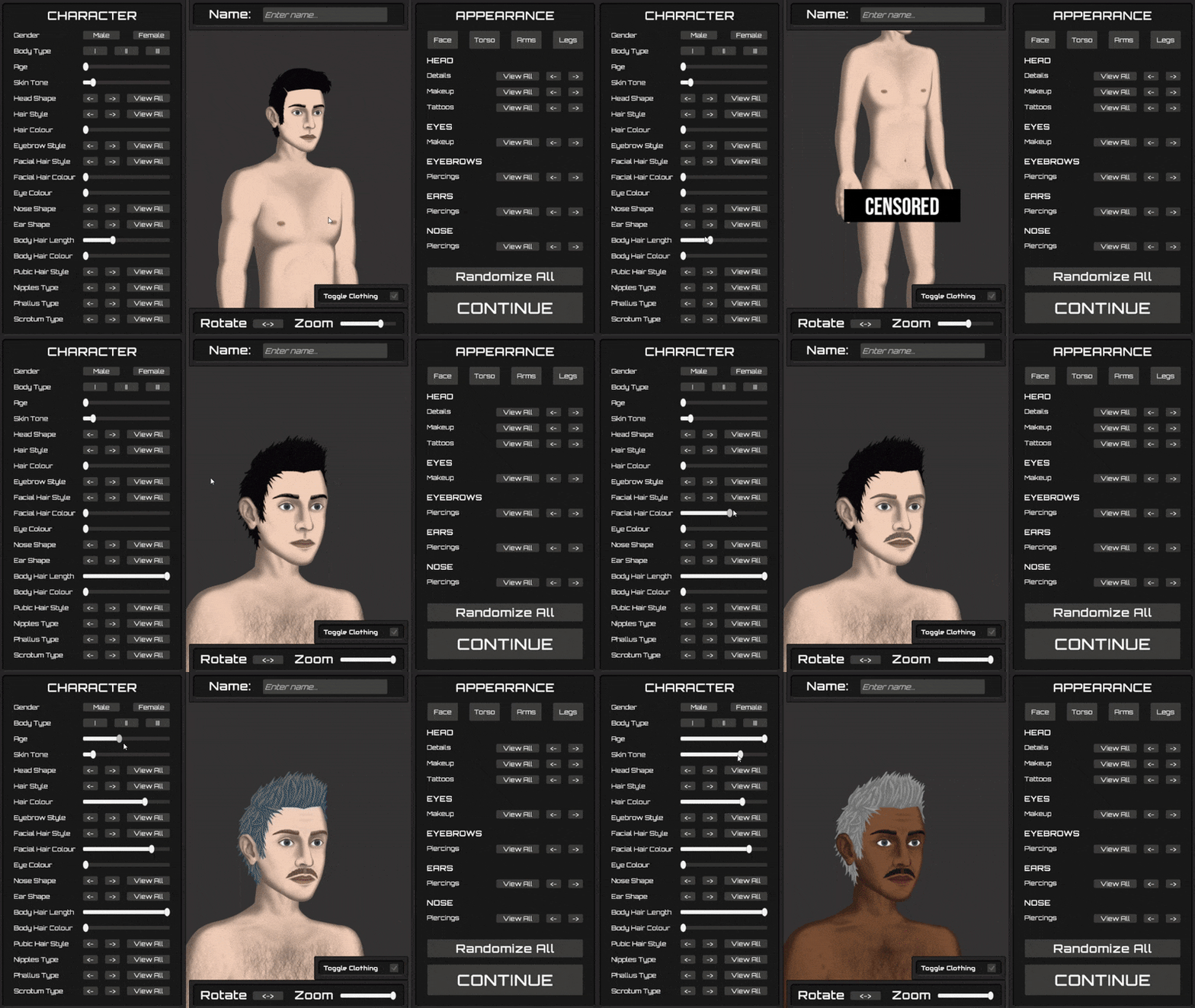
In addition to all the cool new features outlined above, I’ve now FINALLY added some clothing to the game, which means I will no longer be staring at naked people 7 days a week, and you will no longer see an invasive ‘CENSORED’ bar obstructing my fine combinations of pixels. Witness the new underwear below (yes I know, UNDERWEAR, so exciting).
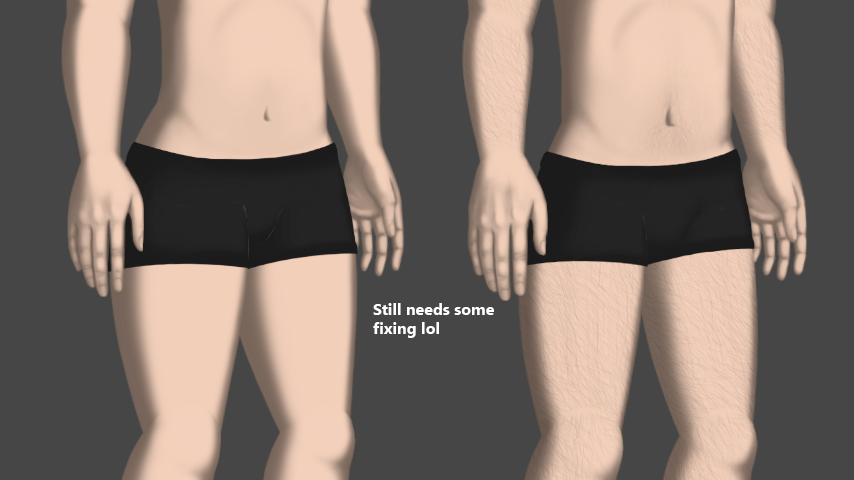
As you can see, it’s still not 100% ready yet, as for some reason the sprites are shrinking(?) or being incorrectly drawn, and aren’t entirely covering the body-part – this will be fixed though so not to worry.
So that’s basically it for this log in terms of in-game stuff. As I mentioned above, there has been a lot more work done than what’s shown here, but it’s honestly just super boring script stuff and it tires me to even think about it – so I won’t make you have to read about it.
Not to fear though, as the next part to this log is quite awesome indeed, let’s take a look.
Wake Up Babe, New Lore Just Dropped
Okay so it took me a bit of time to figure out how to structure this, but in the end I decided I’d just drop the background lore of the game first (it’s really cool) and then after that we can go into the various images and bits of media I’ve created.
So a few logs back, I had provided a very basic timeline of events that led from our current age to the space age, and whilst many of the key technological advances detailed in that post are still relevant, I’ve modified the overall arc quite a bit. I’ll refrain from over-explaining anything here and instead just provide summaries of each era.
Do note, I have redacted some key plot points in the interest of avoiding spoilers, so there is actually more to it than what’s shown here – but I think those parts are best left to discover yourself throughout the course of your playthrough.
It’s also worth mentioning that the majority of the lore is still subject to change and not the final version.
Galactic History of Stellar Wasteland
0AD – 2426AD: The Pre-FTL Age
Humanity’s ascent into the final frontier began with humble steps – lunar colonies, orbital stations, and the first outposts on Mars. But the true turning point came with the near-breakout of World War III. A global anti-war uprising, joined by millions across the planet, stopped the descent into total conflict and instead toppled the corrupted nations of old. From the ashes of nationalism rose a unified planetary assembly, and over the following century, Earth, Luna, and Mars merged under one banner: the United Stellar Federation. United governance brought shared purpose in technology, and culture, and innovation flourished on a scale never seen before.
Advances in fusion, automation, and artificial gravity soon opened the entire Solar System, and the dream of interstellar colonisation became reality. Generation ships carried settlers to Proxima Centauri long before the invention of faster-than-light travel. Yet such breakthroughs brought more than just progress, as the discovery of a hostile alien species once again threatened mankind and plunged the federation into war. The slow wheels of democracy faltered in the face of a sudden existential threat, and as humanity’s colonies burned, the Admiralty seized control in a desperate coup. Twelve brutal years later, the aliens were defeated, democracy was gone, and in its place stood the United Stellar Empire – marking the end of the short-lived Federation, and the beginning of humanity’s imperial age.
2426AD – 3285AD: The Golden Age of Humanity
The birth of the United Stellar Empire marked the beginning of humanity’s greatest era. Under the Emperor’s rule, order replaced chaos, and the trauma of the First Contact War gave way to ambition. Imperial fleets pushed ever outward, establishing colonies, trade routes, and research stations across nearly a hundred light-years of space. A vast network of FTL relays, gravity anchors, and trade corridors, bound the stars togethe and transformed humanity into a far-reaching civilisation. For centuries, prosperity reigned and mankind saw a period of art, science, and expansion that was previusly unmatched in history – even by the Federation’s days.
But at the height of its glory, the seeds of decline started to take root. In the final centuries of the Empire, the Eternity Project was created, and with it, science achieved what legend called impossible: true life extension. At first, the technology was reserved for the most powerful – the Emperor, his kin, and the great noble houses – a gift meant to preserve order and stability. Yet eternity proved a dangerous inheritance… immortality bred ambition, ambition bred paranoia, and whispers of envy slowly turned to secret conspiracies. Among the outer worlds, resentment also grew as the immortal elite ruled from their shining core worlds, detached from the lives of those they governed.
By the dawn of the 33rd century, the Empire’s brilliance hid deep fractures under the surface. Nobles schemed, fleets vanished under mysterious orders, and ancient loyalties eroded into underhanded rivalries. In the palaces of Terra, the immortal bloodline, too, began to fracture. A century later, their feud would ignite a war that would consume the stars. A civil war so devastating that mankind would never again recover from it. The war to end all wars.
3285AD – 3347AD: The Civil War
By the twilight of the Empire’s golden age, the Emperor’s immortality was waning. His body endured, but his strength and mind withered, and talk of succession grew louder with year by year. Among his four heirs, two sons and two daughters, the eldest son was destined for the throne, the second for command, and the sisters for governance. But when the firstborn was reported killed leading a campaign beyond known space, grief and fear gripped the Imperial Court. In an effort to shock his remaining son into responsibility, the Emperor broke centuries of tradition and publicly named his eldest daughter heir; secretly still indending to pass the crown to the boy, but only once he proved himself worthy.
This decision had the opposite effect however, and would instead become the catalyst of their downfall. Consumed by jealousy and fear of being forgotten, the younger son fell prey to his own ambition ajd paranoia. Convinced that destiny had been stolen from him, and urged on by hidden voices that the Empire could not afford weak leadership, he plotted to eliminate his sister and secure his right to rule. But his plan went horribly wrong – the assassin’s blade did not find the heiress, but instead the youngest, most innocent of the royal bloodline. Cornered by his own guilt and desperation, the prince confronted his father and, in a fit of rage, murdered him. The Emperor’s death shattered the illusion of peace, and the Empire teetered on the edge of collapse.
In the chaos that followed, the eldest daughter – heir in name only – seized the throne to prevent further bloodshed. She vowed to restore order, imprison the surviving brother, and bring an end to the madness consuming the court, then abdicate. Yet before she could act, fate dealt another cruel twist: the firstborn son, long since thought dead, had returned from the frontier, unaware of the horror that had unfolded. Seeking to gain his aid in such a dire situation, the Empress sent a message explaining all that had happened. Unbeknownst to her though, nefarious schemes were at work, and her message was altered, making it appear that she murdered their father and siblings, in a bid to seize power for herself.
When the eldest son received the corrupted message, he saw it as proof that his sister had orchestrated their father’s death and stolen his birthright. Enraged and grieving, he declared war in the name of justice and righeousness. What followed was sixty years of devastation: brother against sister, loyalist against loyalist, fleets burning across a hundred worlds and systems. In the war’s final days, the Empress fell by her brother’s hand. It was only after her death, did he uncover the truth of what had really happened. Wracked with guilt, he withdrew from public life, leaving a broken Empire behind. From its ruins rose two new powers, the authoritarian Stellar Empire of Ceti, and the democratic Federal Republic of Sol – forever divided by a tragedy born from love, ambition, and a single lie that no one lived long enough to correct.
3347AD – 3440AD: The Collapse
The civil war had now ended, but its wounds were far too great to recover from. The once-mighty United Stellar Empire lay in ashes, its fleets shattered, its relay network failing, and its people broken by grief and exhaustion. From the wreckage rose two rival powers: the Stellar Empire of Ceti (SEC), ruled from Tau Ceti by the withdrawn and guilt-ridden Silent King, and the Federal Republic of Sol (FRS), reborn on Terra from the ideals of the fallen Empress. Each claimed to be humanity’s rightful heir, yet neither possessed the strength to rebuild the vast dominion they themselves had destroyed.
As the twin powers turned their focus inward, their outward reach quickly faltered. Worlds began to fall silent, FTL relays failed, supply chains collapsed, and piracy reigned at unprecedented levels. The great imperial sphere, once stretching over a hundred light-years, was now reduced to a mere sixty, as outer colonies were either destroyed or abandoned, and communication lines died out. In this chaos, humanity’s oldest enemies saw their chance. Various alien border empires, long dormant beyond the frontier, struck without warning, sweeping through the scattered outer sectors and driving humanity back once more. By the war’s end, the bubble of human space had shrunk to barely thirty light-years.
The century that followed was one of fear and regression. The SEC and FRS entrenched themselves behind fortified borders, rebuilding what little they could while contiuing their accusasions of betrayal. Countless independent worlds withered in isolation, forgotten by the great powers and left to fend for themselves. Yet amidst all the darkness, a fragile spark endured and gave way to the rise of the United Worlds Alliance (UWA). A coalition of worlds, originating from both of the old guard factions, that sought unity through cooperation rather than empire. Its founding marked the faintest renewal of hope…
3440AD: Stellar Wasteland begins…
So there you have it, the history of Stellar Wasteland. TLDR; Everything was great until life extension technology came around, and then everything went to shite. One major civil war, and dozens of subsequent alien invasions later, now everything sucks. Welcome to the wasteland and enjoy your stay.
Believe it or not, the above summaries are actually super condensed/summarised versions of it, as my actual documents are dozens of pages long (I have been quite busy indeed). Funnily enough, the main story of the civil war is actually loosely based upon a plot-line I had originally written for a noble house, way back when SWL was a book (and when it was far more Game of Thrones-ey).
For those that have a keen eye for literature, you’ll have undoubtedly noticed the influences I had when creating this backstory – Macbeth, King Lear, and Othello – all stories based around pride, betrayal, and the cost of human ambition. I definitely did want it to have a sort of ‘Greek Tragedy’ vibe to it, and I think it achieved that goal fairly well.
That being said, all of this is prior history by the time the game is set, and so you as the player won’t be experiencing these events first hand, but instead will live in the world that has been shaped by them (for better or, mostly, worse).
A Side of Artwork Too, Please
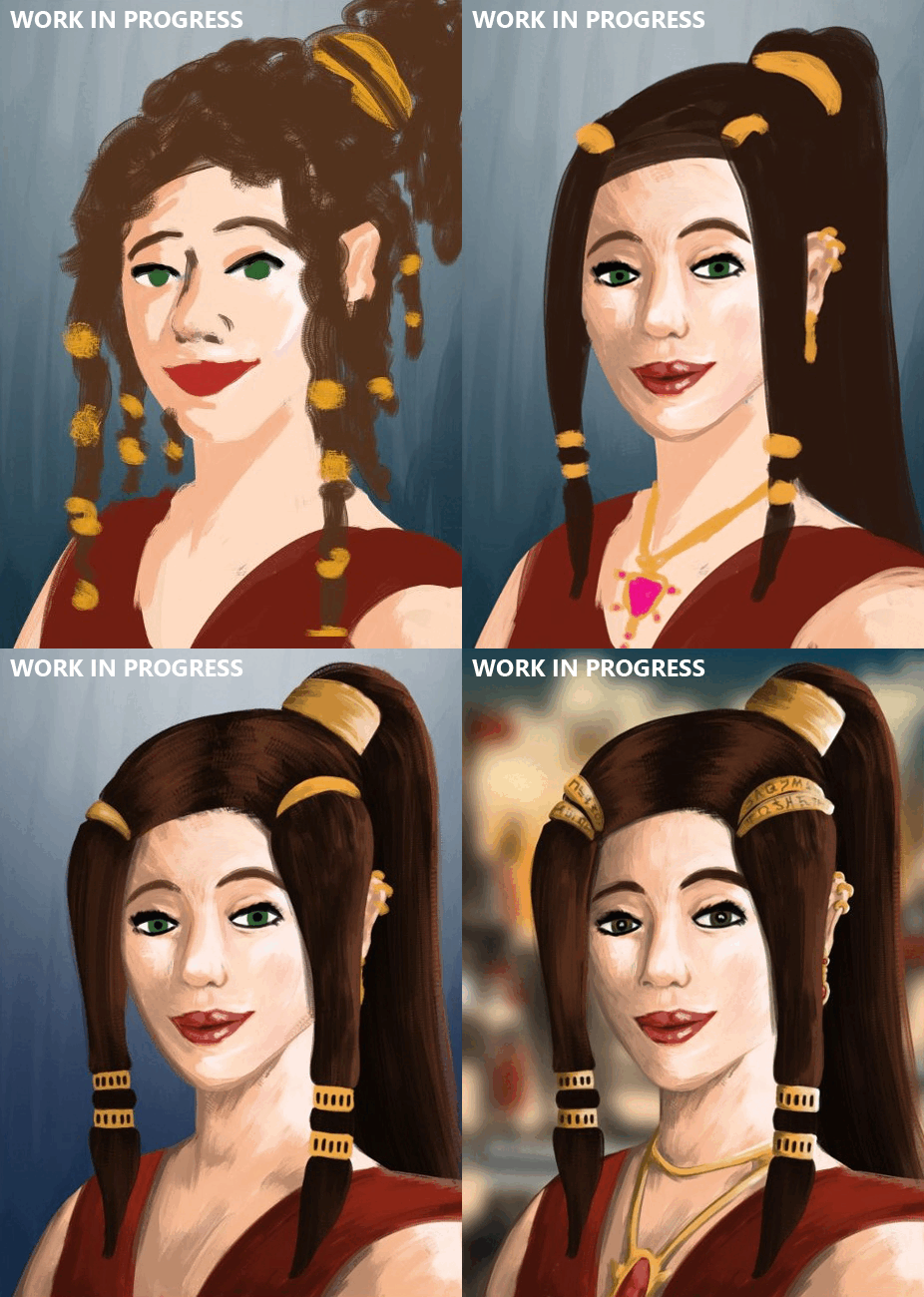
Moving on from the hard lore, I’ve also started working on portraits of some of the central characters, namely the eldest daughter to start with, but I’ll eventually get around to doing all the key figures. These portraits are not only for the in-game codex, and in-world art you may find, but also for the Wiki I’ll soon be creating for this website (but more on that in a later log).
The GIF below shows you the in-progress shots of the portrait, and I think so far it’s turning out quite nice.. I have gone for a new style of painting for this artwork, more in line with traditional oil paintings rather than the typical ‘digital art’ style I do. I don’t think I’m as good in this style as my usual one – but you can be the judge yourself.
In addition to the character portraits, I’ve also been working away at creating all the factions – including their history, governance, culture, goals, characteristics, geography, and – most importantly for this log – their flags. Below you will see one such flag, for the Federal Republic of Sol.

One thing I’ve always found slightly jarring across most Sci-Fi fiction, is that traditional flags are almost always swapped out for intricate symbols instead. I mean, I do get *why*, since IFF codes and technological advances mean that you’d no longer have to display visual identification like naval battles of old, but to me it just seems a tad generic.
So with the above in mind, I’m giving each faction a true traditional flag, rather than just a symbol. In designing these flags, I’m also trying to ensure they actually have meaning behind their composition rather than just ‘rule of cool’ – and so to that end, the FRS flag shows Sol (the gold star) surrounded by the eight planets in our system, as the central symbol of the flag. In addition, the 10 stars along the bottom of the flag represent the 10 systems that are under FRS control, with the gold chevron pointing forward to represent progress.
Now obviously I’m no philosopher, and so this isn’t intended to be super deep, but I am hoping that all these extra details and hidden meanings do end up amounting to a far richer and more immersive world overall.
Another really cool thing I’ve whipped up is this (very early) mockup of the in-game galaxy map. This version is not representative of how it will look in game, but more-so intended to showcase the playable area and unique regions that can be encountered. The map also showcases the 25 real-world star systems that I will be including in game, of which I painfully researched one by one to obtain their distance and relative bearing from Sol, and then used these details to place each system as accurately as possible to their real world location (with some minor changes where required).
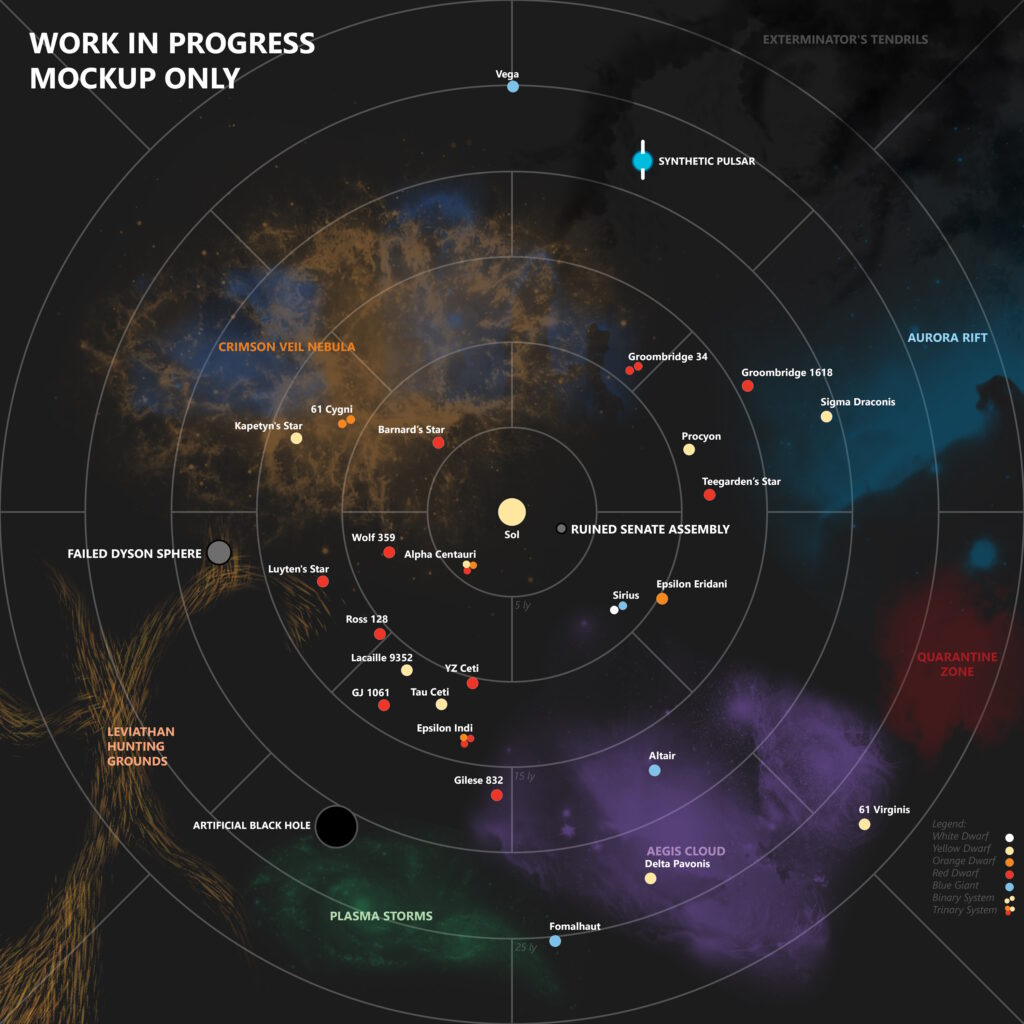
Now I will say, the names of the regions themselves are just VERY early placeholders and I will change them in time to not be so cliche (Crimson Veil in particular).
The map itself definitely follows the age-old game design rule of making inner sections safer and outer sections more dangerous. It currently only has 25 real-world star systems, but I will be further expanding this by another 25 fictional ones, to end up with around 50 total systems in the final game – as well as ensuring I allow plentiful space for mod-added systems.
When creating the actual features of the map (nebulas, megastructures, black hole, pulsar) I definitely took quite a bit of fictional liberty to explain their addition, since the IRL region around Sol is actually quite bland and definitely doesn’t contain any such things. Ultimately though, I think it’s fine, since the game world itself is more-so a mix between realism (Expanse) and fantasy (Warhammer 40,000), whilst not quite on either end of the spectrum entirely.
I will be going into greater detail about many of these regions and landmarks in a later dev log, but for now all I’ll say is that some of these regions will include things such as zombie viruses, spaceborne predators, rogue machines, corrosive clouds, psychosis-inducing gases, hostile lifeforms, and much more cool Sci-Fi goodness.
So that about wraps up all the lore-related stuff I can share today, but rest assured there is much much more behind the scenes. I definitely don’t want to reveal all my cards this early on though, and I think I’ve rambled for long enough today anyway, so I’m just gunna leave things here.
Whew, that was a big one – hopefully you enjoyed it though, as it’s been a blast writing and drawing all this stuff.
You may have noticed this post was a great deal less formal and, I suppose, less refined in terms of writing, compared to prior dev logs. This is due to the fact that, this time, I haven’t gone back and edited/re-written all the paragraphs like I usually do.
Even without the usual editing pass, this post took like 2.5 hours to create (including both the writing and the preparation of GIFs/images) yet, funnily enough, I consider that a win. If I had actually gone through and edited, re-formatted, improved structuring, and refined flow, like I’ve done in all the prior logs, then it would have easily been a 4-5 hour affair.
The reason for this, as I touched on in the prior log, is that I’ve been looking at ways of reducing the time it takes to write these fortnightly updates. Right now, between work and development (Monday through to Saturday), and world-building/writing/painting in the evenings, I really only have Sunday as the one day each week where I have actual free time. And Sunday is the day I do these dev-logs (rip).
I do hope this more informal style of writing isn’t *too* jarring compared to before, as I think I will continue to write the dev logs in this way. Any unique or ‘special’ posts will get the full editing treatment of course, just not the fortnightly logs (man needs at least a bit time off lol).
As always, thanks for tuning in and I’ll catch ya in the next one!